Escape Transforms
Colors are displayed in Fred's Fractal Viewer by mapping the Mandelbrot or Julia Escape Counts to indexes into the 256 color palette. The indexes into the palette range from 0 to 255.
Identity Transform
- The 0 index is reserved for the background color which is used to paint the pixels with an Escape Count >= MaxIterations.
- The mapping for pixels with an associated Escape Count < MaxIterations: palette color index = (Escape Count % 255) + 1 .
The Identity Transform is used by default when an .efractal file is first opened in Fred's Fractal Viewer. However, after the user has added locales to an .efractal file, one of those locales becomes the default locale. When the .efractal file is subsequently opened in the Viewer, the default locale for the .efractal file will be activated. Whatever Escape Transform is specified in the default locale effectively becomes the default Escape Transform for that .efractal file.
Div N Transform
- The 0 index is reserved for the background color which is used to paint the pixels with an Escape Count >= MaxIterations.
- The mapping for pixels with an associated Escape Count < MaxIterations: palette color index = ((Escape Count)/N % 255) + 1 .
Use the View->Escape Transform>Config menu item to set the N value for the Div N transform.
Quasi Log EscCnt/N Transform
- The 0 index is reserved for the background color which is used to paint the pixels with an Escape Count >= MaxIterations.
- The mapping for pixels with an associated Escape Count < MaxIterations: palette color index = ( G(N, Escape Count) % 255) + 1 .
G(N, x) is a discrete function defined for positive integers N and x. G( N, x) is as follows:
- If x <= N, then G(N, x) = x.
- If x > N and x <= 3*N, then G(N, x) = G(N, N) + (x - N)/2 = N + (x - N)/2 .
- If x > 3*N and x <= 7*N, then G(N, x) = G(N, 3*N) + (x - 3*N)/4 = 2*N + (x - 3*N)/4 .
- If x > 7*N and x <= 15*N, then G(N, x) = G(N, 7*N) + (x - 7*N)/8 = 3*N + (x - 7*N)/8 .
- for integer k, If x > ((2**k) - 1)*N and x <= ((2**(k+1) - 1)*N, then G(N, x) = k*N + (x - ((2**k) - 1)*N)/(2**k) .
Note that the function G(N, x) can be roughly approximated by the function GG(N, x) = N*log_base2((x + N)/N) .
So why use this? Consider the following fractal region displayed with the Identity transform followed by the Quasi Log transform:
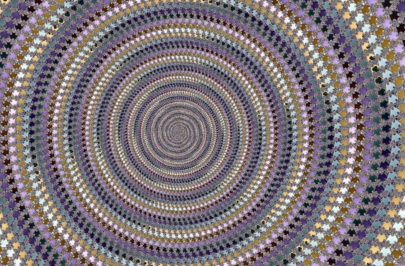
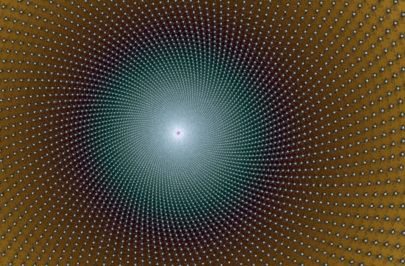
Use the View->Escape Transform>Config menu item to set the N value for the Quasi Log EscCnt/N transform.